Wife Lucy Lane Clifford
Queer Places:
University of Cambridge, 4 Mill Ln, Cambridge CB2 1RZ
Highgate Cemetery East, Swain, Highgate, London Borough of Camden, Greater London N6 6PJ England
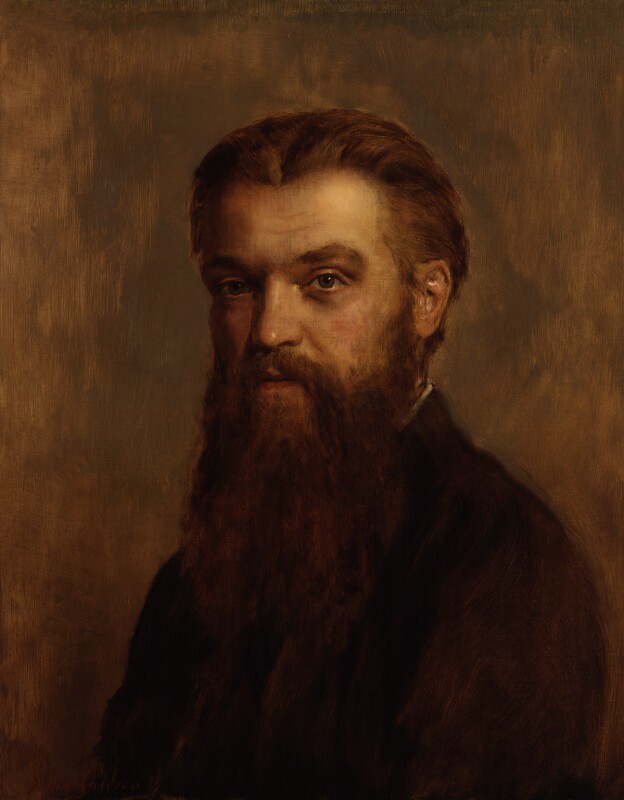 William Kingdon Clifford (May 4, 1845 – March 3, 1879) was a brilliant British mathematician and philosopher whose work anticipated major developments in modern physics.
Despite his short life, he made lasting contributions to geometry, algebra, and the philosophy of science.
William Kingdon Clifford (May 4, 1845 – March 3, 1879) was a brilliant British mathematician and philosopher whose work anticipated major developments in modern physics.
Despite his short life, he made lasting contributions to geometry, algebra, and the philosophy of science.
Born in Exeter, England, on May 4, 1845, Clifford displayed exceptional intellectual ability from a young age. After attending schools in Exeter, he entered King’s
College, London, at age 15. In 1863, he moved to Trinity College, Cambridge, where he thrived as a student. He graduated as Second Wrangler in 1867 and was elected a
Fellow of Trinity College in 1868.
During his time at Cambridge, Clifford became a member of the Cambridge Apostles. This was an elite, secretive
intellectual society limited to a small number of distinguished students. The society was known for fostering open, honest, and rigorous debate on challenging social,
religious, and philosophical issues. Clifford’s participation in the group helped shape his intellectual development and reflected his growing status among the era's
leading young thinkers.
Clifford is best known for developing Clifford algebra (and geometric algebra), which is now fundamental to fields like physics, geometry, and computer science.
His 1876 paper, "On the Space-Theory of Matter," hypothesized that physical matter and energy are essentially different types of curvature in space—a concept that
predated Einstein’s general theory of relativity by decades.
Clifford was a staunch advocate of rationalism and a "humanist ethics without religion". In his famous essay, The Ethics of Belief (1877), he argued that it is
immoral to hold beliefs without sufficient evidence.
In 1871, he became a professor of mathematics and mechanics at University College London. He was elected a Fellow of the Royal Society in 1874.
Clifford’s health was often fragile, and he suffered from pulmonary illness, likely exacerbated by his intense work habits. In 1875, he married
Lucy Jane Lane, a future celebrated author. After multiple attempts to recover his health in warmer climates, he died of
tuberculosis in Madeira, Portugal, on March 3, 1879, at the age of 33. His epitaph, which he composed himself, reflects his humanist outlook: "I was not, and was
conceived: I loved, and did a little work: I am not, and grieve not".
- https://www.britannica.com/biography/William-Kingdon-Clifford
- https://en.wikipedia.org/wiki/William_Kingdon_Clifford
- https://www.newworldencyclopedia.org/entry/William_Kingdon_Clifford
- https://mathshistory.st-andrews.ac.uk/Obituaries/Clifford_RAS/
- https://heritage.humanists.uk/william-kingdon-clifford/
- https://www.encyclopedia.com/history/historians-and-chronicles/historians-miscellaneous-biographies/william-kingdon-clifford
- https://devonandexeterinstitution.org/clever-clifford-the-life-and-work-of-william-kingdon-clifford/
Support this project
This website is a passion project researched, developed, and funded entirely by me. If you find the content valuable and would like to help support the ongoing research and hosting costs, any contribution is deeply appreciated.
Thank you for keeping this independent resource alive!
My books on Amazon: Elisa Rolle's books
BACK TO HOME PAGE